SPACE // CALENDAR
SPACE // CALENDAR
SPACE // CALENDAR
SPACE // CALENDAR
SPACE // CALENDAR
SPACE // CALENDAR
SPACE // CALENDAR
.jpg)

The first woman in space, Soviet cosmonaut Valentina Tereshkova, flew in 1963. However space flight programs did not include women after her until the 1980s. show moreSince then many women from a range of countries have worked in space, though overall women are still significantly less often chosen to go to space than men and represent only 10% of all astronauts who have been to space.[3] Three countries maintain active space programs that have included women: China, Russia, and the United States. In addition, a number of other countries — Canada, France, India, Iran, Italy, Japan, South Korea, and the United Kingdom — have sent women into orbit or space on Russian or US missions. Most women in space have been United States citizens, with missions on the Space Shuttle and on the International Space Station. Women in space face many of the same challenges faced by men: physical difficulties posed by non-Earth conditions and psychological stresses of isolation and separation. Scientific studies on female amphibians and non-human mammals generally show no adverse effect from short space missions.show less

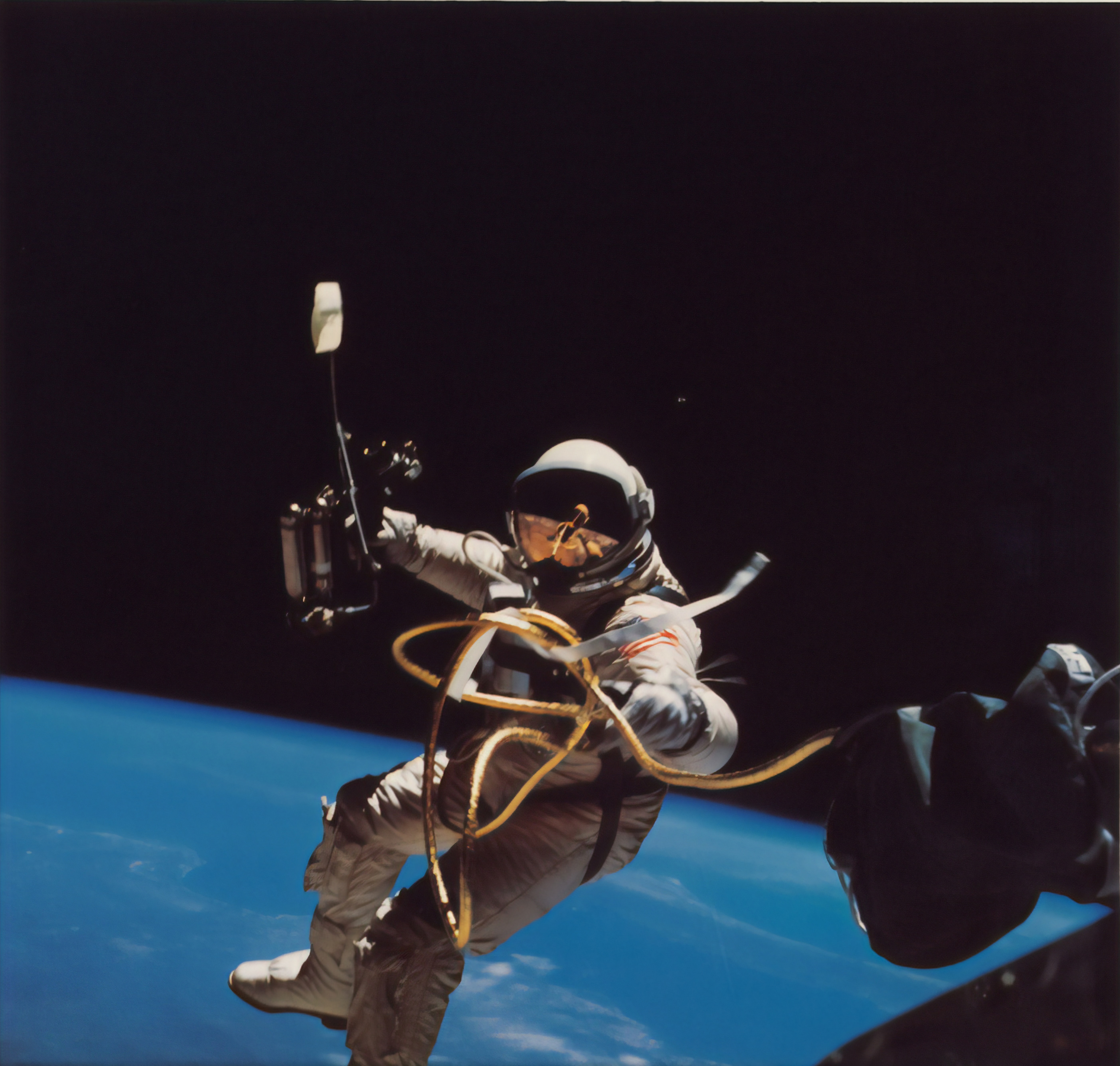
LExtravehicular activity (EVA) is any activity done by an astronaut or cosmonaut outside a spacecraft beyond the Earth's appreciable atmosphere. The term most commonly applies to a spacewalk made outside a craft orbiting Earth (such as the International Space Station). On March 18, 1965, Alexei Leonov became the first human to perform a spacewalk, exiting the capsule during the show more Voskhod 2 mission for 12 minutes and 9 seconds. The term also applied to lunar surface exploration (commonly known as moonwalks) performed by six pairs of American astronauts in the Apollo program from 1969 to 1972. On July 20, 1969, Neil Armstrong became the first human to perform a moonwalk, outside his lunar lander on Apollo 11 for 2 hours and 31 minutes. On the last three Moon missions astronauts also performed deep-space EVAs on the return to Earth, to retrieve film canisters from the outside of the spacecraft. Astronauts Pete Conrad, Joseph Kerwin, and Paul Weitz also used EVA in 1973 to repair launch damage to Skylab, the United States' first space station. A "Stand-up" EVA (SEVA) is when an astronaut does not fully leave a spacecraft, but is completely reliant on the spacesuit for environmental support.[1] Its name derives from the astronaut "standing up" in the open hatch, usually to record or assist a spacewalking astronaut. EVAs may be either tethered (the astronaut is connected to the spacecraft; oxygen and electrical power can be supplied through an umbilical cable; no propulsion is needed to return to the spacecraft), or untethered. Untethered spacewalks were only performed on three missions in 1984 using the Manned Maneuvering Unit (MMU), and on a flight test in 1994 of the Simplified Aid For EVA Rescue (SAFER), a safety device worn on tethered U.S. EVAs. The Soviet Union/Russia, the United States, Canada, the European Space Agency and China have conducted EVAs.show less